




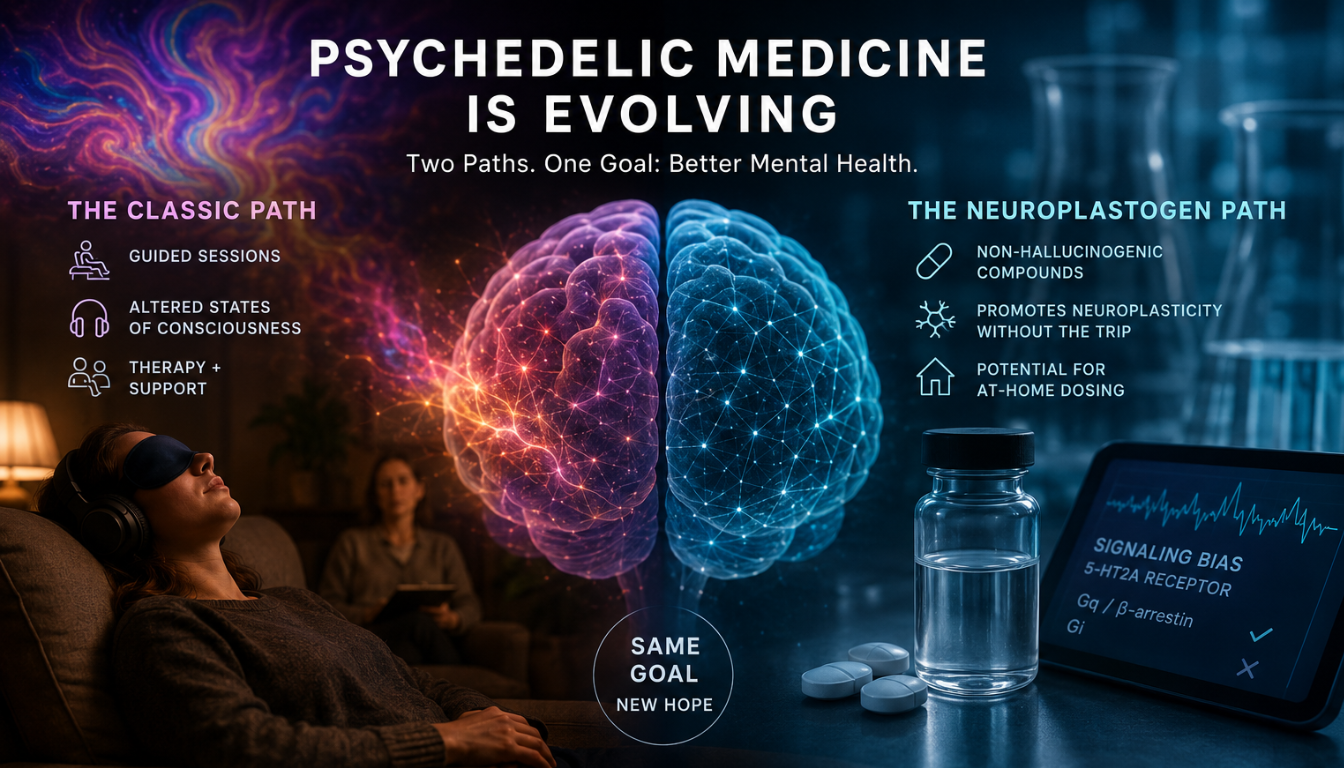
For most of the last decade, the story of psychedelic medicine was a story about the trip itself. Guided sessions. Eyeshades and headphones. A therapist sitting with a patient for six or eight hours while a single dose of psilocybin or MDMA did its work. That was the model — expensive, logistically heavy, and philosophically tied to the idea that the altered state of consciousness was the medicine.
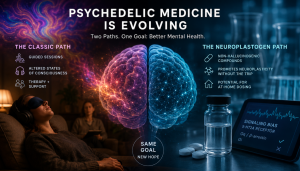
Walking into the second half of 2026, that’s no longer the whole industry. A quieter, more clinical wing of psychedelic drug development has grown up alongside the classic guided-session model, built on a simple bet: that the mood and anxiety benefits associated with psychedelics come from changes in brain wiring — neuroplasticity — rather than from the hallucination itself. If that bet is right, you might be able to keep the therapeutic upside and lose the eight-hour supervised session, the psychotherapy requirement, and a good chunk of the cost and complexity that comes with dosing someone with a Schedule I hallucinogen.
Two Camps, One Underlying Science
The field now roughly splits into two camps chasing related but distinct strategies.
The first is the classic-psychedelic camp, still betting that the full drug — LSD, psilocybin, MDMA — delivered under clinical supervision is the winning formula. Compass Pathways has the most advanced psilocybin program in the space, with pivotal Phase 3 data now in hand. Definium Therapeutics (the company formerly known as MindMed) is running three separate pivotal Phase 3 trials of its LSD candidate for generalized anxiety and major depression, and has a second program in R(-)-MDMA aimed at autism spectrum disorder. GH Research is working with 5-MeO-DMT. These programs still involve real hallucinogenic experiences, real monitoring requirements, and — increasingly — real regulatory scrutiny over exactly what “supervision” needs to look like.
The second camp is the neuroplastogen camp: companies designing molecules that engage some of the same serotonin receptor machinery as classic psychedelics, especially the 5-HT2A receptor, but engineered — or selected — to avoid the signaling pathways believed to drive hallucination. Delix Therapeutics is probably the most closely watched name here; its lead candidate produced early clinical signals of rapid symptom improvement in major depression without hallucinogenic or dissociative effects, and the FDA cleared a Phase II design that allows at-home dosing — a level of regulatory comfort that would be unthinkable for a full-dose psilocybin trial. A cluster of smaller, earlier-stage companies are chasing similar non-hallucinogenic neuroplastogen strategies aimed at depression, anxiety, and neurodegenerative disease. On the ibogaine side, one company has spent years developing noribogaine, the non-hallucinogenic active metabolite of ibogaine, while several others continue work on ibogaine derivatives more broadly, some hallucinogenic and some not. In addiction medicine, at least one Nasdaq-listed company is testing a non-hallucinogenic candidate for alcohol use disorder that recently cleared its primary safety and tolerability endpoint in an early trial.
Big pharma has started placing bets too. AbbVie’s acquisition of Gilgamesh Pharmaceuticals — a company working across both hallucinogenic and non-hallucinogenic mood and stress compounds — was one of the clearest signals yet that the neuroplasticity thesis is being taken seriously outside the specialist biotech world, not just inside it.
The Science Behind the Split
What’s driving the split isn’t just business strategy — it’s an actual, evolving scientific argument about how these drugs work at the receptor level.
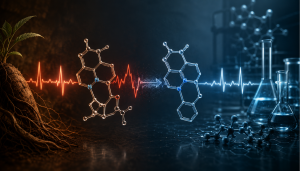
Classic psychedelics activate the 5-HT2A serotonin receptor, and for years that receptor’s activation was treated as basically synonymous with the psychedelic experience. But receptor activation isn’t a single on/off switch — a receptor can trigger several different intracellular signaling cascades depending on which molecule is binding to it and how, a phenomenon pharmacologists call “biased agonism.” Recent research, including a 2026 study published in Nature, has argued that one specific downstream pathway — Gi-mediated signaling at the 5-HT2A receptor — is closely tied to hallucinogenic effects, while other pathways at the same receptor, including Gq and β-arrestin signaling, appear to be more closely associated with the antidepressant- and anxiolytic-like effects seen in preclinical models. If a compound can be designed to lean into the Gq/β-arrestin side of that signaling split while avoiding the Gi pathway, the theory goes, it might replicate the therapeutic benefit without the trip.
That’s still an emerging, contested area of pharmacology — the mechanistic link between specific signaling bias and subjective human experience is inferred largely from preclinical assays and animal behavioral models, not yet proven in large human studies. But it’s become the organizing scientific framework a growing number of drug developers are designing around, and it’s part of why so many recent non-hallucinogenic drug announcements lean on receptor-signaling assay data — BRET, cAMP, and similar live-cell tests — as their primary evidence, well before any of these molecules reach human trials.
Why the FDA’s New Guidance Is a Bigger Deal Than It Looks
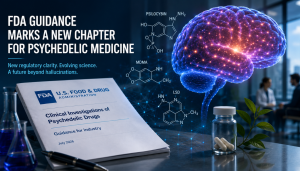
Regulation has become just as important to this split as the biology. On July 13, 2026, the FDA finalized long-awaited guidance titled “Psychedelic Drugs: Considerations for Clinical Investigations,” closing out a draft that had been sitting since 2023. The agency was explicit that psychedelic programs face the same regulations and evidentiary standards as any other drug development program — no shortcut, no discount for enthusiasm.
But the substance of the guidance makes clear just how much extra work classic hallucinogenic programs are signing up for. The FDA devotes significant attention to functional unblinding — the well-documented problem that patients and observers can usually tell who received the real drug versus placebo simply because one group is hallucinating and the other isn’t, which can skew both expectations and reported outcomes. The agency also recommends two trained monitors per dosing session plus on-call physician access within fifteen minutes, and signals — more strongly than in the 2023 draft — that it expects many approved psychedelics to carry a Risk Evaluation and Mitigation Strategy (REMS) after launch, addressing risk not just to patients but to bystanders as well, given the drugs’ abuse potential and street value. The agency also flagged new formal driving-study recommendations, another sign it’s treating post-dose impairment as a serious, ongoing safety question rather than a one-day inconvenience.
None of that applies with the same force to a compound that doesn’t produce a hallucinogenic experience in the first place. A drug that behaves, pharmacologically, like a fast-acting antidepressant rather than a mind-altering substance can plausibly run through more conventional blinded trial designs, skip the multi-hour supervised dosing sessions, and avoid a lot of the REMS conversation altogether — assuming its non-hallucinogenic profile actually holds up once it’s tested in real patients rather than cell assays and animal models.
That’s the commercial logic driving so much recent investment into the neuroplastogen side of the field: if it works, it’s a meaningfully cheaper and more scalable product to bring to a doctor’s office than a supervised eight-hour psilocybin session ever will be.
The Political Tailwind
This isn’t happening in a vacuum. An April 2026 executive order, “Accelerating Medical Treatments for Serious Mental Illness,” directed federal agencies to speed up psychedelic drug research — including breakthrough therapy vouchers, expanded Right to Try access, and $50 million in dedicated research funding. The Department of Health and Human Services has separately solicited feedback on training and care-delivery models for administering psychedelic therapies in outpatient settings, including rural clinics and community health centers, in anticipation that some of these drugs eventually clear FDA approval. The FDA has also scheduled a public hearing in September 2026 specifically on the future therapeutic use of psychedelic drugs.
The political mood music, in other words, has shifted from cautious tolerance to active encouragement — a sharp turn from where the conversation stood even five years ago, when psilocybin and MDMA were treated almost entirely as Schedule I curiosities with a research exemption.
What Still Has to Be Proven
For all the momentum, it’s worth being honest about how early most of this still is. The receptor-signaling science separating “hallucinogenic” from “non-hallucinogenic” pathways is compelling but young, built substantially on cell-based assays and animal studies rather than large controlled human trials. Several of the non-hallucinogenic neuroplastogen programs generating buzz — and press releases — are still preclinical, meaning no human has yet been dosed. Even the more advanced ones are only now generating early-stage human data. And on the classic-psychedelic side, pivotal Phase 3 readouts expected through 2026 will be the real test of whether the guided, full-dose model can clear the FDA’s evidentiary bar at all, REMS requirements and all.
What’s changed is the shape of the industry’s bet. Five years ago, virtually every psychedelic drug company was selling some version of the same story: a supervised, transformative experience as the core product. Today, a serious and growing share of the field is betting the experience was never the point — that the real value was happening in the brain’s wiring the whole time, and the trip was just a side effect worth engineering away. Whether that bet pays off is still an open, unresolved question. But it’s now a real fork in the road for an entire category of medicine, not a fringe idea, and the next couple of years of clinical data — from both camps — should start to settle it.
